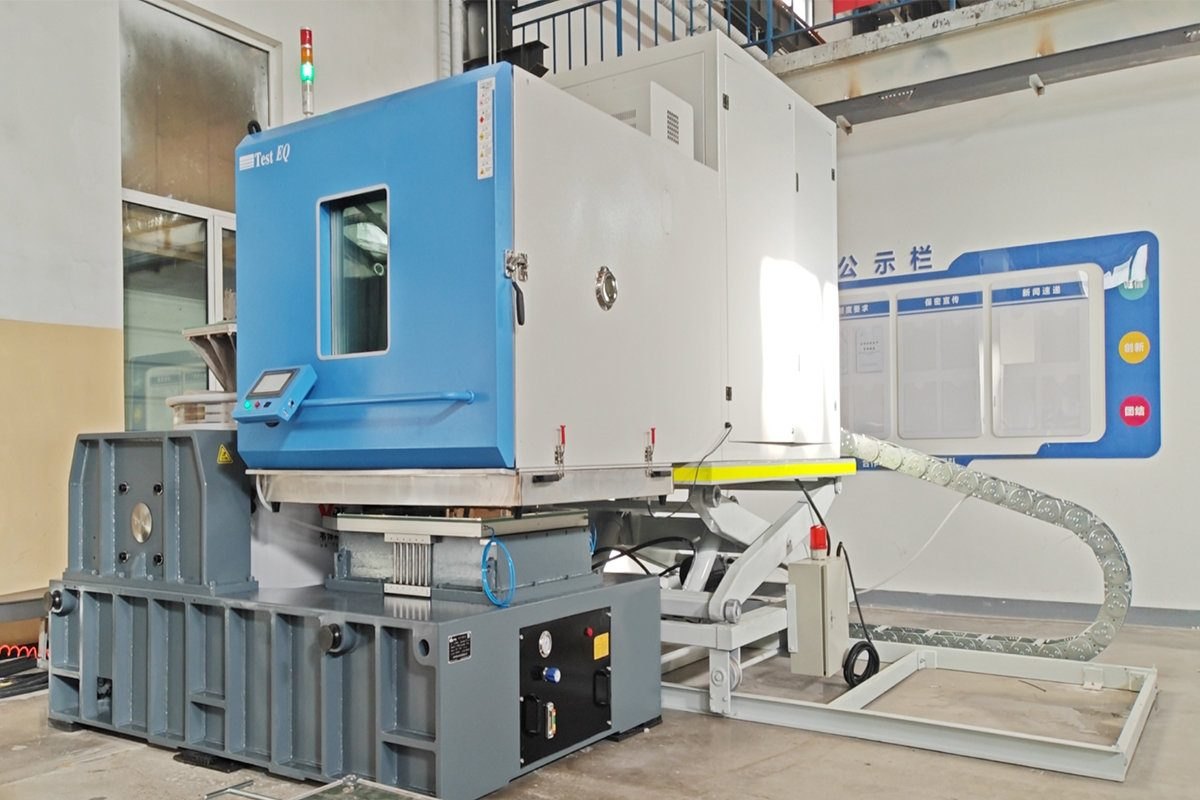
The TestEQ four combined environmental test chamber integrates temperature, humidity, vibration and altitude simulation into one coordinated test platform. It is built for products that must operate or survive under combined climatic, mechanical and reduced-pressure conditions, and it is configured around the actual qualification program rather than a single nominal chamber volume.
What a four combined chamber is
A four combined environmental test chamber controls temperature and humidity while applying mechanical vibration and altitude or low-pressure conditions. The four environmental factors are programmed according to the required qualification sequence rather than run as four separate tests. The system may include temperature conditioning, humidity control, low-pressure / altitude simulation, electrodynamic vibration, customized specimen fixtures, environmental monitoring and programmable test control.
The four environmental factors
- Temperature — the chamber controls heating and cooling according to the programmed test profile.
- Humidity — relative humidity can be controlled when moisture exposure is part of the qualification requirement.
- Vibration — an integrated or externally coupled shaker applies the required mechanical excitation.
- Altitude — pressure control simulates reduced atmospheric pressure corresponding to high-altitude conditions. The exact altitude range depends on the chamber design and the required test procedure.
Products in high-altitude and aerospace environments can meet several of these stresses at the same time. Temperature affects material properties and thermal expansion; humidity can influence corrosion and electrical insulation; vibration creates mechanical loading; reduced pressure can affect heat transfer, sealing, insulation and component behaviour. Testing them together gives a more representative qualification program when the product specification requires it.
Applications
- Aerospace and avionics equipment exposed to changing temperature, humidity, vibration and altitude conditions
- Automotive and EV components used across different elevations and operating environments
- Defense electronics requiring multiple environmental stress factors
- High-reliability electronic assemblies and communication equipment
- Sensors and complex electronic assemblies with combined thermal, moisture, mechanical and altitude requirements
Configuration and features
- Integrated 4-in-1 environmental simulation system with simultaneous control of temperature, humidity, vibration and altitude.
- Multi-axis vibration testing (X/Y/Z configurable).
- Programmable environmental stress profiles.
- Real-time synchronized control system.
- High-stability chamber structure for long-duration testing.
- Modular design for different industry requirements.
- Vertical, horizontal and application-specific vibration integration, designed around the selected electrodynamic shaker.
- Pressure range, transition requirements and holding conditions configured according to the qualification program.
- Temperature, humidity, pressure and vibration parameters managed as one programmable test sequence.
- Chamber dimensions, access configuration, specimen fixtures, shaker interfaces, cable routing and monitoring customizable for complex specimens.
Specifications
Model range
| Model | Capacity (m³) | Internal dimension W×H×D (mm) | External dimension W×H×D (mm) |
|---|---|---|---|
| EQTH-05 | 0.5 | 800×800×800 | 1950×1900×3950 |
| EQTH-12 | 1.2 | 1050×1000×1150 | 2250×2100×4350 |
| EQTH-20 | 2 | 1200×1200×1400 | 2120×2150×4500 |
| EQTH-30 | 3 | 1400×1350×1600 | 2300×2000×5350 |
| EQTH-50 | 5 | 1600×1600×1800 | 2300×2280×5350 |
| EQTH-60 | 6 | 1900×1600×2200 | 2900×2300×5500 |
| EQTH-90 | 9 | 2000×2000×2300 | 2400×2600×6620 or 3060×2900×5500 |
| EQTH-100 | 10 | 2200×2000×2600 | 2600×2650×6300 or 3260×2900×5800 |
Note: the external dimensions above are given without the vibration tester’s height. Vibration shaker table dimensions include 640×640 mm, with other sizes customized according to the selected shaker.
Common specifications
| Parameter | Value |
|---|---|
| Temperature range | -70 °C to +180 °C (200 °C optional) |
| Temperature fluctuation | ≤ ±0.5 °C |
| Temperature uniformity | ≤ 2.0 °C |
| Temperature deviation | ≤ ±2.0 °C |
| Humidity range | 20 % to 98 % RH (10 % to 98 % RH / 5 % to 98 % RH optional) |
| Humidity deviation | +2 % to -3 % RH (≥ 75 % RH); ±5 % RH (≤ 75 % RH) |
| Pressure range | atmospheric pressure to 0.5 kPa |
| Pressure time | atmospheric pressure to 1 kPa ≤ 30 min |
| Pressure recovery time | ≤ 10 kPa/min |
| Rapid decompression time | 75.0 kPa to 19 kPa ≤ 15 s (optional) |
| Cooling system | Wind cooling or water cooling / single-stage compressor (-40 °C); double-stage compressor (-70 °C) |
| Structural style | S - elevator, L - gantry elevator, G - fixture type |
| Optional accessories | Inner door with operation hole, recorder, water purifier, dehumidifier |
| Power | AC 380 V, 3-phase, 5-line, 50/60 Hz |
Actual specifications depend on chamber size, shaker system, altitude requirement and test profile.
Four combined vs three combined
The difference between the four combined chamber and a three combined chamber is the altitude or low-pressure dimension. A three-factor system combines temperature, humidity and vibration; the four combined system adds controlled pressure reduction for high-altitude operating conditions.
| Environmental test system | Temperature | Humidity | Vibration | Altitude / low pressure | Typical application |
|---|---|---|---|---|---|
| Temperature Vibration Test Chamber | ✓ | — | ✓ | — | Thermal-mechanical reliability testing |
| Temperature Humidity Vibration Test Chamber | ✓ | ✓ | ✓ | — | AGREE and combined climatic-vibration testing |
| Four Combined Environmental Test Chamber | ✓ | ✓ | ✓ | ✓ | Aerospace, avionics and high-reliability environmental qualification |
Choose a four combined configuration when reduced-pressure or altitude simulation is part of the qualification program. For three-factor work, see the Temperature Humidity Vibration Test Chamber . For pressure simulation without combined vibration, see the Altitude (Low-pressure) Test Chamber ; for large specimens, see the Walk-in Environmental Chamber .
Standards
Systems can be configured around applicable environmental qualification requirements:
- IEC 60068 series — temperature, humidity, vibration and combined environmental stress testing for electronic components, aerospace systems and industrial products.
- MIL-STD-810H — military and aerospace qualification, including temperature, humidity, vibration, altitude and harsh environmental simulation.
- RTCA DO-160 — aerospace equipment qualification covering temperature variation, altitude, humidity and vibration.
- ISO 16750 — automotive and EV component reliability evaluation for vehicle electronics, battery systems and automotive assemblies.
- JESD22 — semiconductor package and electronic device reliability verification with thermal, humidity and mechanical stress evaluation.
The applicable test method should be confirmed before final equipment configuration.
Contact
To size a chamber and shaker around a qualification program, contact us with the test standard, temperature range, humidity requirement, vibration profile (frequency, acceleration, displacement, axis), altitude or minimum pressure requirement, specimen dimensions and mass, and whether the conditions are simultaneous or sequential.