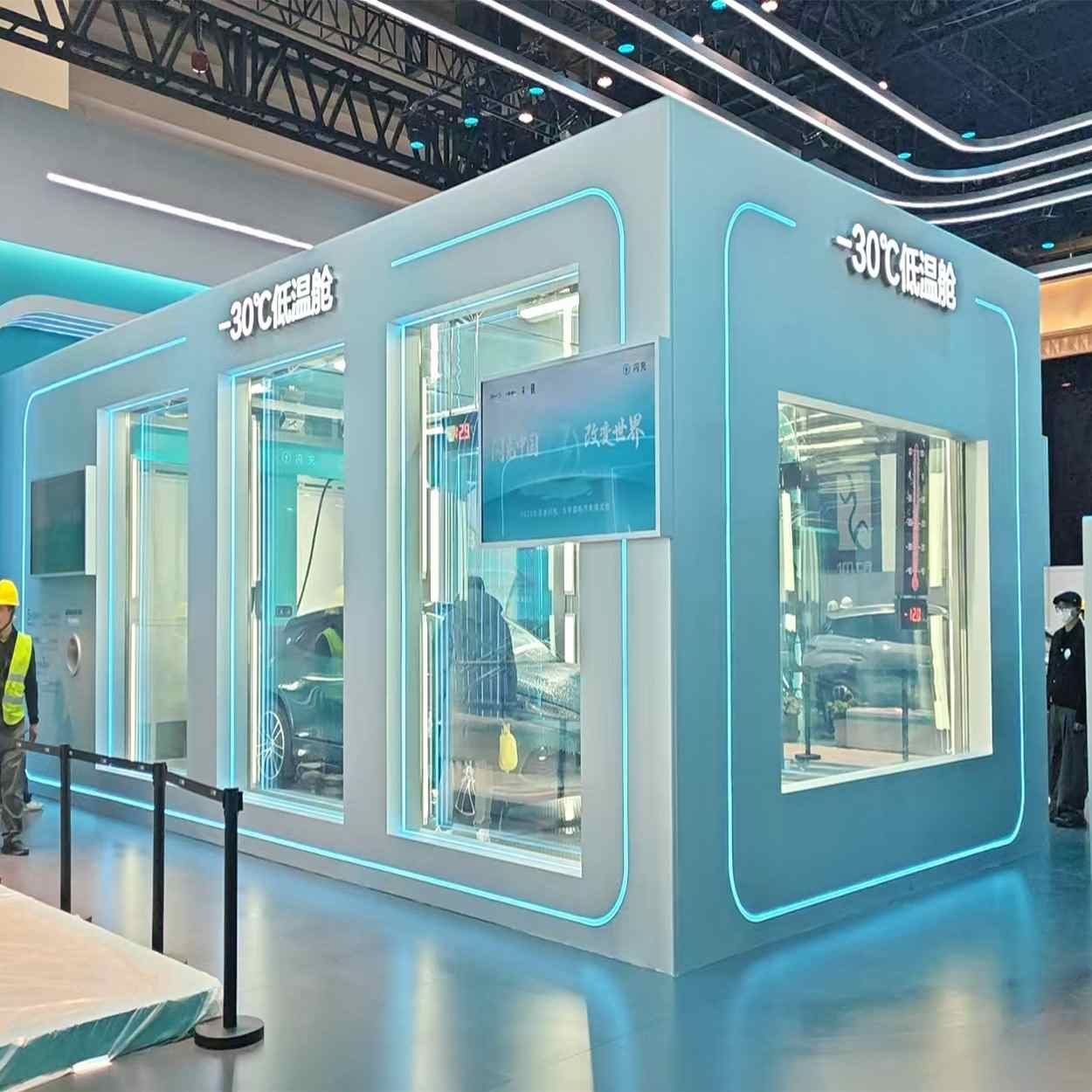
The TestEQ icing test chamber grows a controlled layer of ice on a test item and holds it there long enough to run functional checks. Cooling and water-spray sequences are configured around the specimen, so a component, a subassembly or a full vehicle can be frozen, sprayed and tested in the same cabinet. It is used wherever equipment has to keep working after ice has formed on it — airborne equipment qualified against an icing requirement, and automotive or outdoor hardware exposed to freezing rain and road spray.
Applications
- Automotive components and vehicle subassemblies
- Full vehicles and large assemblies, tested on the same platform as small DUTs
- Airborne equipment and avionics icing qualification
- Outdoor, exposed and roadside equipment
- Functional reliability checks carried out while ice is still present on the item
Configuration and features
- Controlled ice accretion, so the same icing condition can be repeated between runs.
- Configurable cooling and spray sequences for rapid icing tests.
- Engineered water-spray systems for freezing rain simulation.
- Vehicle and component testing, from small DUTs to full vehicles.
- Chamber engineering based on the applicable test standards and DUT requirements.
- Functional reliability testing under controlled ice accumulation.
The chamber is not built around a fixed catalogue size. Internal dimensions, cooling arrangement, spray layout and the sequence that drives them are defined together with the specimen and the test profile, so a test programme can be matched to the item rather than the other way round.
Standards
The icing requirement referenced for these systems is RTCA DO-160, Environmental Conditions and Test Procedures for Airborne Equipment. In DO-160G the icing requirement sits within Sections 24–26, the specialized safety and environmental group that also covers electrostatic discharge, fire and flammability. Icing profiles differ between qualification programmes and equipment categories, so the applicable section and the item under test decide the chamber configuration and the spray system.
Chamber sizing
Two things drive the layout: how large the item is, and how the ice has to be distributed across it. A sensor or an actuator housing and a full vehicle place very different demands on the working volume, the spray coverage and the sequence that runs the test. Tell us the specimen, the applicable standard section and the icing condition to be reproduced, and we will configure the chamber around them.
To match a chamber to an icing or freezing rain profile, contact us with the specimen dimensions, the applicable RTCA DO-160 section and the required ice accumulation. Related: Walk-in Environmental Chamber , Altitude (Low-pressure) Test Chamber , Thermal Shock Test Chamber .