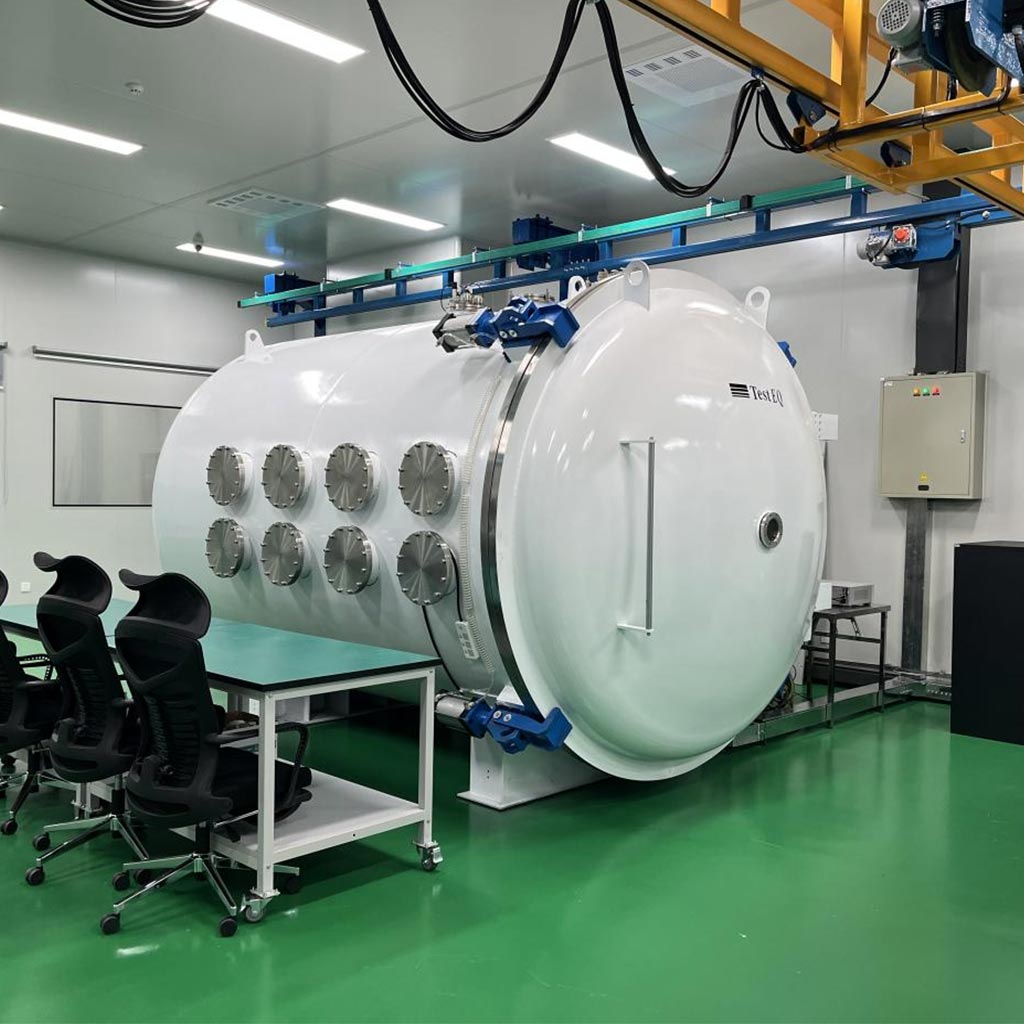
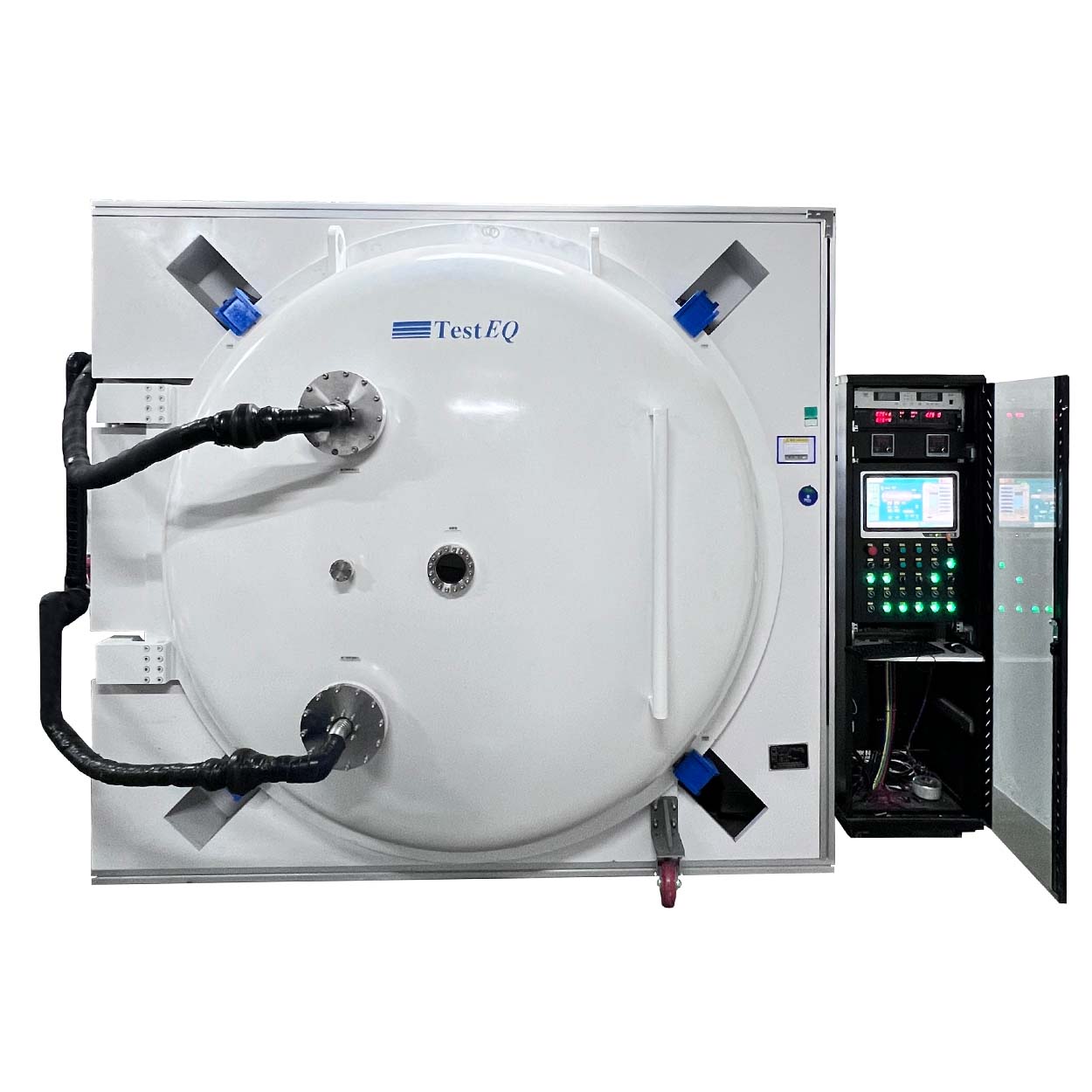
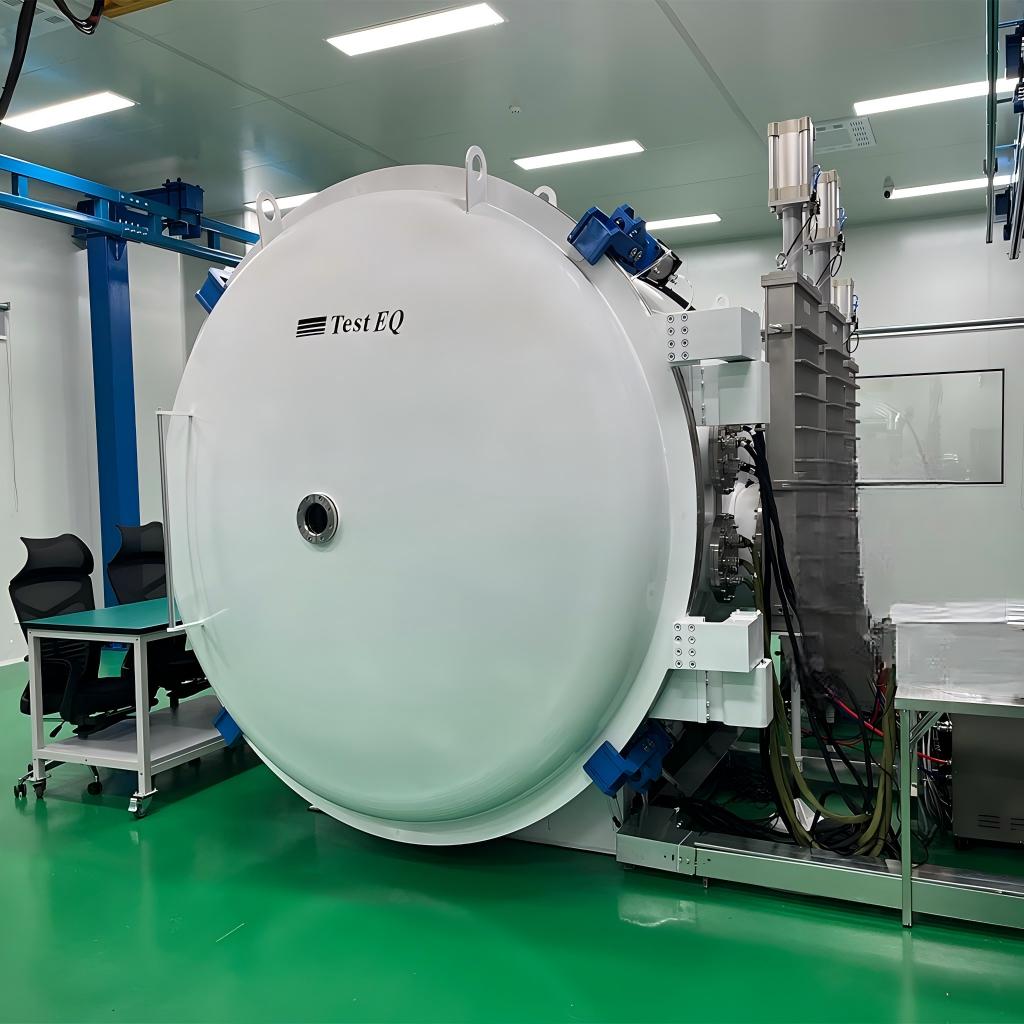
The TestEQ thermal vacuum chamber reproduces the combined low-pressure and thermal conditions faced by equipment operating in space, for space simulation and for thermal cycling under vacuum. It provides high-vacuum performance together with an ultra-wide thermal range, allowing vacuum and thermal cycling to be applied at the same time.
Applications
- Spacecraft, satellite and space equipment testing
- Aerospace components and instruments
- Semiconductor equipment and precision components
- Outgassing and material evaluation under vacuum
- Components requiring combined vacuum and thermal cycling
Configuration and features
- High vacuum level to 1.0×10⁻⁷ mbar.
- No-load vacuum level 5×10⁻⁷ mbar at room temperature.
- Temperature range -190 °C (liquid nitrogen cooling) to +200 °C.
- Simultaneous vacuum and thermal cycling capability.
- Stable pressure regulation across multiple vacuum levels.
- Chamber, shroud and cooling system configured around the test item and required temperature profile.
- Patent number CN202510795397.6.
Specifications
Model range
| Parameter | EZKT 1000-5 | EZKT 1200-5 | EZKT 1700-5 |
|---|---|---|---|
| Capacity | 0.402 m³ | 0.785 m³ | 2.65 m³ |
| Thermal shroud internal dimension (straight cylindrical section) | ø 800×800 mm | ø 1000×1000 mm | ø 1500×1500 mm |
| Vacuum chamber internal dimension (straight cylindrical section) | ø 1000×1000 mm | ø 1200×1200 mm | ø 1700×1700 mm |
| Thermal plate dimension | 600×500 mm | 800×700 mm | 1300×1200 mm |
Common specifications
| Parameter | Value |
|---|---|
| Capacity range | 0.5 m³ to 2.65 m³ (customizable) |
| High vacuum level | 1.0×10⁻⁷ Torr (1.33×10⁻⁷ mbar) |
| No-load vacuum level | 5.0×10⁻⁷ mbar (room temperature) |
| Pressure regulation in multiple ranges | stable operation at 1.0×10⁻², 1.0×10⁻³, 1.0×10⁻⁴, 1.0×10⁻⁵ and 1.0×10⁻⁶ mbar/Torr (room temperature) |
| Vacuum cube leak rate | ≤ 1×10⁻⁹ std/cc/sec |
| Refrigeration modes | A: thermal sink + cold plate; B: thermal sink + heating cage; C: liquid nitrogen thermal sink + heating cage |
| Temperature range | gaseous nitrogen control -180 °C to +200 °C; mechanical refrigeration -80 °C to +150 °C; flooded liquid nitrogen -190 °C |
| Temperature uniformity | ±2 °C (measured at any point on the heat sink and cold plate under stable conditions in a vacuum environment) |
| Rising / falling rate (mechanical cooling) | -70 °C to +100 °C ≥ 3 °C/min; +100 °C to -50 °C ≥ 3 °C/min |
| Rising / falling rate (optional, pressurised GN₂ recirculation) | -150 °C to +125 °C ≥ 3 °C/min; +125 °C to -150 °C ≥ 3 °C/min |
| Vacuum acquisition system | mechanical pump / roots pump / molecular pump / cryopump |
| Power | AC 380 V, 3-phase, 5-line, 50/60 Hz |
| Patent | CN202510795397.6 |
System configuration options
| System component | Standard configuration | Custom configuration |
|---|---|---|
| Vacuum vessel | ✓ | ✓ |
| Chamber volume | ✓ | ✓ |
| Vacuum pumping system | ✓ | ✓ |
| Thermal shroud | ✓ | ✓ |
| Cold plate | Optional | ✓ |
| Heating system | ✓ | ✓ |
| Cooling system | ✓ | ✓ |
| Payload fixture | Optional | ✓ |
| Electrical feedthrough | Optional | ✓ |
| Residual gas analyzer (RGA) | Optional | ✓ |
| Data acquisition system | Optional | ✓ |
| Thermal balance | Optional | ✓ |
| Solar simulation | Optional | ✓ |
| Automated control | ✓ | ✓ |
Vacuum levels in the 10⁻⁵ to 10⁻⁷ Torr/mbar range are commonly associated with spacecraft TVAC qualification depending on mission requirements.
Standards
Thermal vacuum systems are configured around the customer’s space-simulation or vacuum-thermal test specification. Commonly referenced standards include NASA thermal vacuum testing requirements, ECSS-Q-ST-70-02 spacecraft thermal vacuum testing, MIL-STD-810 low-pressure and temperature testing, and ASTM E595 outgassing testing. To define the chamber, pumping system, shroud and thermal profile, contact us with the test item and required conditions. Related: Altitude (Low-pressure) Test Chamber , Custom Non-standard Test Chamber .