Environmental testing exists to answer one question before a product reaches the field: will it still work after years of heat, cold, moisture, and vibration? For engineers working in aerospace, automotive, semiconductor, battery, and electronics development, the answer is usually pursued through standardized test programs. Among these, IEC 60068 remains one of the most widely referenced families of standards for climatic and mechanical testing.
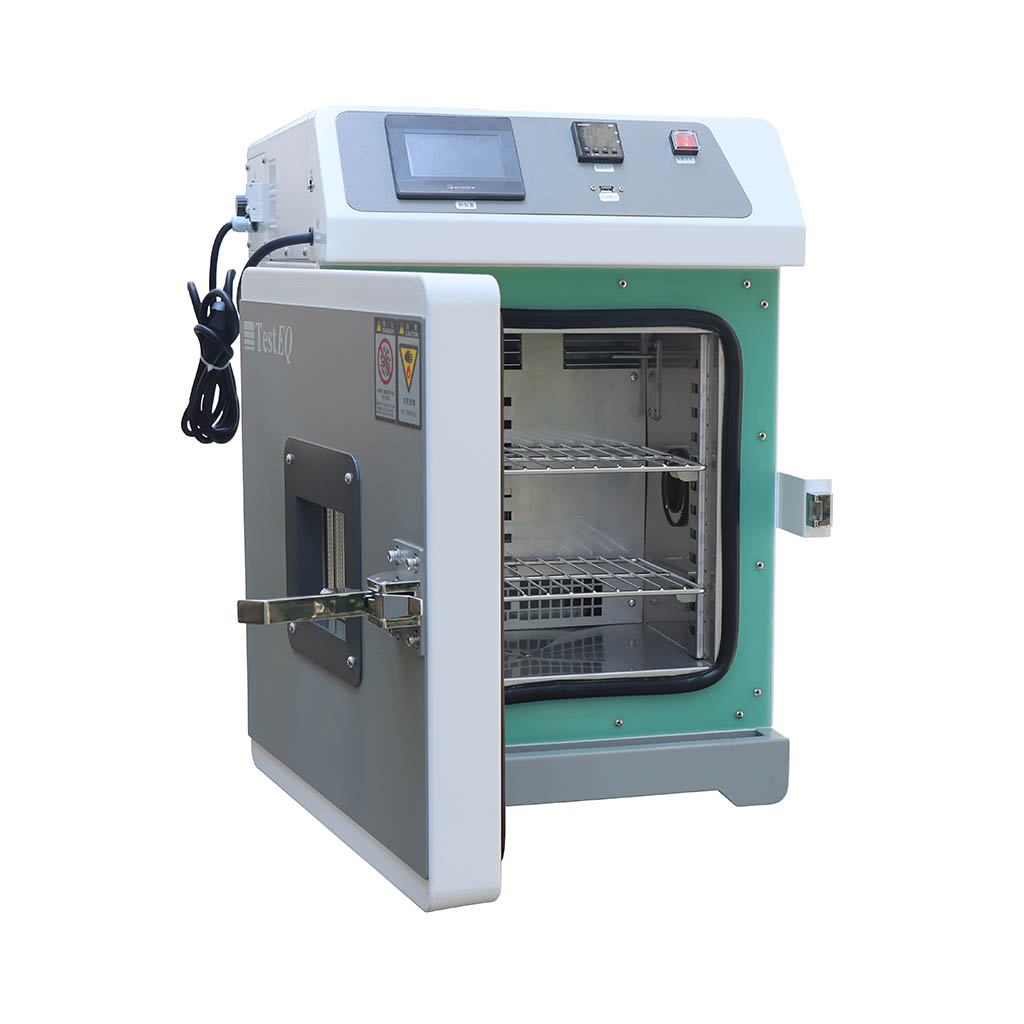
This article explains what IEC 60068 covers, how humidity and temperature tests are structured, and what to examine when selecting a high-low temperature humidity chamber or a related system.
What IEC 60068 Actually Covers
IEC 60068 is published in parts, and each part addresses a different environmental stress category. The parts most often cited in chamber procurement are:
- IEC 60068-2-1 — Cold testing
- IEC 60068-2-2 — Dry heat testing
- IEC 60068-2-30 — Damp heat, cyclic (12 h + 12 h cycle)
- IEC 60068-2-78 — Damp heat, steady state
- IEC 60068-2-14 — Change of temperature (thermal cycling and shock)
- IEC 60068-2-38 — Composite temperature/humidity cyclic test
The distinction between steady-state and cyclic damp heat matters for equipment selection. Steady-state tests hold a fixed temperature and relative humidity for a defined duration, which places sustained demands on humidity control stability. Cyclic tests ramp between conditions, sometimes with condensation phases, which places demands on transition rate, recovery time, and the prevention of unintended condensation on the chamber itself.
A related standard, IEC 60068-2-38, combines temperature cycling with humidity exposure in a single profile. Chambers intended for this work need coordinated control of both variables rather than independent loops that fight each other.
Temperature and Humidity Ranges in Practice
A common working range for general-purpose climatic chambers is around -70 °C to +180 °C, with extended platforms reaching -75 °C to +200 °C. Humidity control typically spans roughly 10 %RH to 98 %RH, though the achievable envelope narrows at temperature extremes. This is a physics constraint, not a vendor limitation: at very low temperatures the moisture content of air is negligible, and at high temperatures near 100 °C the dew point relationship limits how much relative humidity can be maintained.
When reviewing a specification sheet, look at the humidity range stated at a specific temperature, not a single headline number. A chamber rated to 98 %RH at +25 °C may only reach 20 %RH at +85 °C. Test profiles that demand high humidity at elevated temperature require careful verification against the actual performance envelope.
Other parameters worth examining:
- Temperature uniformity across the working volume, usually expressed as a tolerance at a defined setpoint
- Fluctuation at the control sensor, which differs from uniformity
- Heat-up and pull-down rates, linear or averaged, and whether they are specified with or without a live load
- Humidity uniformity and response time after a setpoint change
Matching Chamber Type to Test Intent
Not every temperature or humidity requirement belongs in the same box. The table below maps common test intents to equipment categories.
| Test intent | Typical equipment |
|---|---|
| Steady-state damp heat, IEC 60068-2-78 | High-low temperature humidity chamber |
| Cyclic damp heat, IEC 60068-2-30 | High-low temperature humidity chamber with programmed ramps |
| Rapid thermal cycling | Rapid temperature change chamber |
| Extreme thermal shock, two-zone transfer | Thermal shock chamber |
| Combined temperature, humidity, vibration | Three-axis integrated (AGREE) chamber |
| Altitude and low pressure simulation | Altitude chamber |
| Space environment simulation | Thermal vacuum chamber |
| Highly accelerated life testing | HALT/HASS chamber |
| Large assemblies, full vehicles | Walk-in chamber |
The choice between a rapid temperature change chamber and a thermal shock chamber is frequently misunderstood. Rapid change chambers move the air inside a single workspace; thermal shock chambers move the product between two preconditioned zones. The latter produces far steeper product-level transitions but offers less control over intermediate dwell behavior.
For programs that combine vibration with climate, a three-axis integrated chamber allows simultaneous excitation and climatic exposure, which better reflects real service conditions than sequential testing. More detail on configuration options is available under /projects/ .
Standards Beyond IEC: Where Profiles Diverge
IEC 60068 is not the only framework. Many industries layer additional requirements:
- MIL-STD-810 — U.S. military environmental engineering considerations, widely adopted in aerospace and defense
- GJB — Chinese national military standards, often paired with MIL-STD methods
- ISO 16750 — Road vehicles, environmental conditions for electrical and electronic equipment
- JEDEC JESD22 — Semiconductor device reliability, including moisture sensitivity
- ASTM and UL — Material and product safety testing with climatic elements
The practical consequence is that a single chamber may need to satisfy several profiles. When specifying equipment, list every standard and method you expect to run, then confirm the temperature range, humidity range, ramp rates, and dwell tolerances each one requires. A chamber sized for steady-state damp heat may be inadequate for a rapid cycling profile from a different standard.
Selection Checklist
Before requesting a quotation, gather the following:
- Test standards and methods you must comply with, including revision year
- Temperature range with margin beyond your highest and lowest setpoints
- Humidity range at each temperature, not just at ambient
- Ramp rate required, and whether it applies to the product or the air
- Dwell time and tolerance at each plateau
- Load description — mass, material, power dissipation, and fixturing
- Chamber volume relative to load, since a large load in a small chamber slows recovery
- Utility requirements — power, water, drainage, and compressed air
- Data logging and traceability needs for audit or qualification reports
Load characteristics deserve particular attention. A powered device dissipating heat inside the chamber changes the thermal balance, and a hygroscopic load can absorb or release moisture, disturbing humidity control. Sharing these details early avoids surprises during commissioning.
Summary
IEC 60068 provides a structured vocabulary for climatic testing, but the standard alone does not tell you which chamber to buy. The decisive factors are the specific methods you must run, the humidity and temperature envelope at each setpoint, the ramp and dwell tolerances, and the nature of the load. Engineers who map those requirements before evaluating equipment tend to end up with a chamber that supports their qualification program rather than constraining it.
For application-specific guidance across aerospace, automotive, semiconductor, battery, and research environments, see /applications/ and /solutions/ . Technical notes on chamber design and control architecture are collected under /tech/ , and configuration questions can be directed through /contact/ .