
A walk-in chamber is chosen when the specimen is too large or too heavy for a cabinet, or when a whole assembly has to be tested. Two decisions dominate the design: how the enclosure is built, and how uniform conditions are held across a large volume.
Panel or welded construction
We build walk-in chambers two ways. Assembly panels — polyurethane-cored sandwich panels — go together quickly, ship flat and can be reassembled on site, which suits standard temperature and humidity duty. The constraint is the core: polyurethane has an upper temperature limit of 85 °C. Once the upper temperature must exceed 85 °C, or the duty calls for a faster rate of temperature change, high-temperature-and-humidity conditions, welded construction is used instead. A welded enclosure supports a higher temperature range and a faster rate.
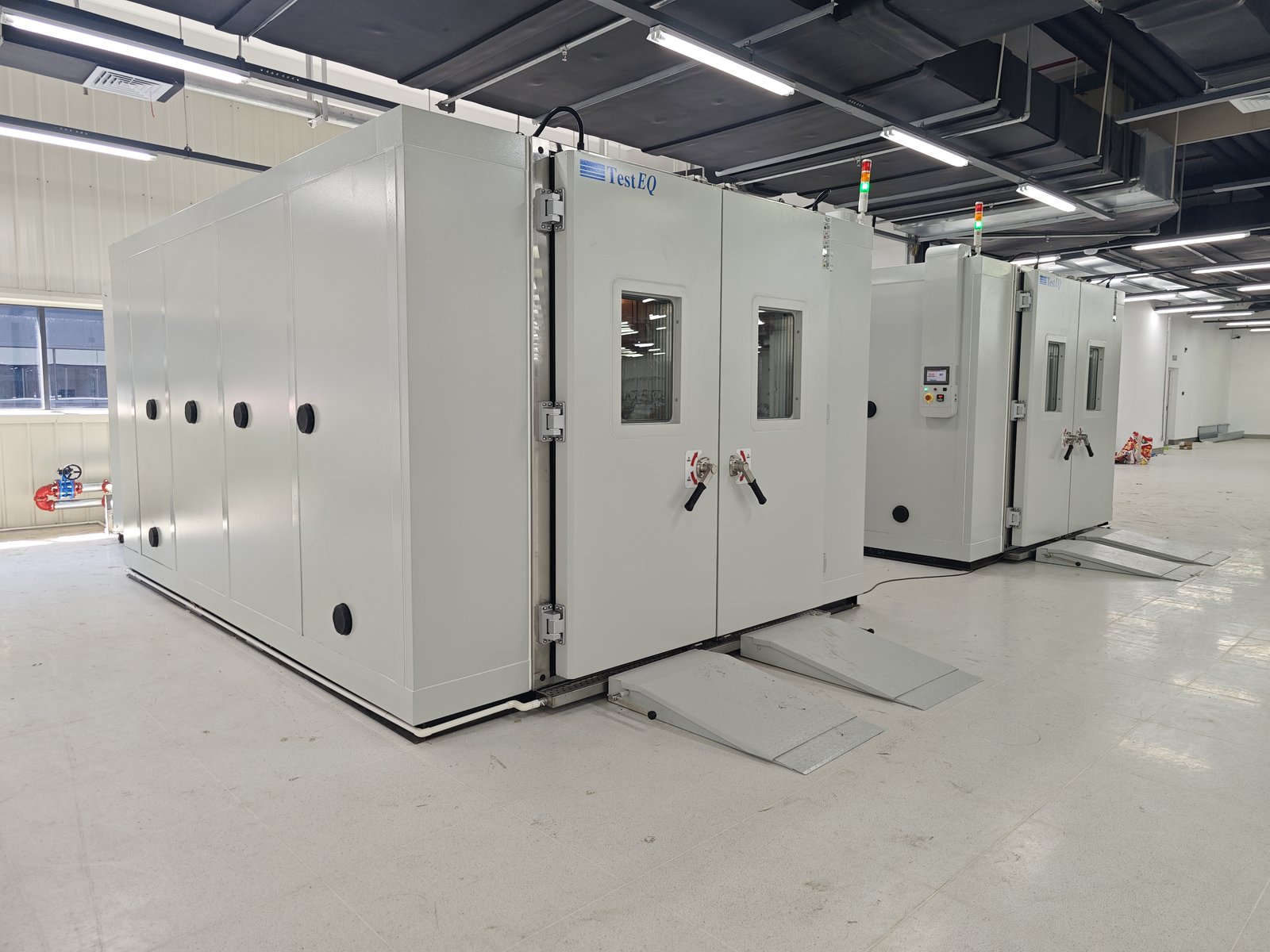
The rule is simple: upper limit at or below +85 °C with a modest rate → assembly panels; above +85 °C, or a rapid-change or high-temperature-humidity duty → welded construction.
Holding uniformity in a large volume
The main risk in a large chamber is a temperature and humidity gradient across the working space. It is controlled by ducting and airflow organisation: air is delivered evenly across the specimen zone and dead corners are avoided. Because the working volume is large, the number and placement of supply and return air paths is decided together with the load arrangement, not after it. The EWTH walk-in series holds temperature uniformity ≤ 2.0 °C, temperature fluctuation ≤ ±0.5 °C and temperature deviation ≤ ±2.0 °C. A specimen that blocks the airflow path will spoil uniformity no matter what the chamber can do, so the load has to be arranged with a clear path for the air.
Construction and fit-out details
- Anti-condensation heater wire embedded in the door and chamber frame, switched on automatically when the internal temperature falls below the dew point, so extreme cold is not carried to the outside of the enclosure.
- Two φ100 mm cable ports, one in each side plate, with elastic grommets.
- A movable ramp for sample carts.
- Heavy-duty castors and levelling feet.
- Main supply earth-leakage protection, lighting, over-temperature protection, emergency stop, run and fault indicators and a buzzer.
- An electrically heated four-layer hollow-glass viewing window.
Controller
A 7-inch colour touch screen with program and constant modes; 20 editable programs of up to 50 steps with 20 cycles each; display resolution 0.1 °C, 0.1 minute and 0.1% RH; RS-485 communication for up to 16 units on a total cable length of 800 m; fault alarm with cause and remedy prompts, power-failure protection, upper and lower temperature limits, timer and self-diagnosis.
Site
The chamber needs more than floor space: a floor drain for condensate and a controlled laboratory ambient temperature.
Size range
The EWTH walk-in series covers 7.8 to 44.1 m³ in temperature classes of −10, −20, −40 and −65 °C up to +85 °C. Contact us with the specimen envelope, weight and duty and we will confirm the construction and the size.