
Both tests move a product between hot and cold, and both are ordered by temperature range. They are not the same machine and they do not test the same failure mode. The difference is in how the temperature change is produced.
The mechanism is different
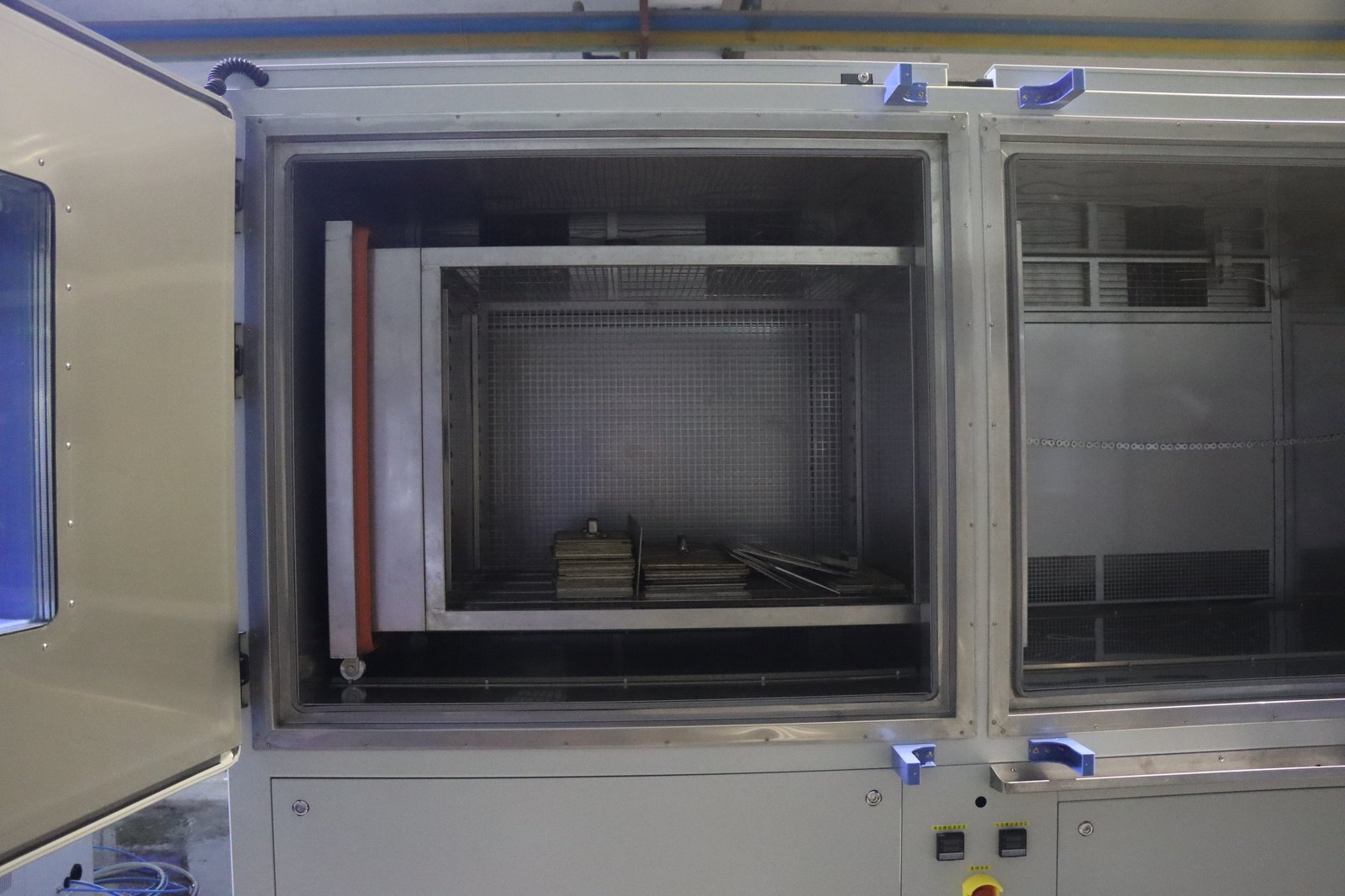
Thermal shock moves the specimen between two or three separately controlled temperature zones and lets the transfer itself create the transient stress. An ETS series chamber does this either with an air-moved damper between zones or with a basket that travels between a hot and a cold zone. Transition time is ≤3–10 s and temperature recovery is ≤0.5–3 min. The specimen experiences a step, not a ramp.
Rapid temperature change keeps the specimen in one chamber and changes the air temperature at a controlled rate. The EATH series is offered in 5, 10 and 15 °C/min steps, up to 30 °C/min. The specimen sees a continuous rate, and the rate can be tied to the specimen surface rather than the air.
The standards are different
Thermal shock sits under IEC 60068-2-14, MIL-STD-810H Method 503.7, MIL-STD-202 Method 107 and GJB150.5A-2009. Rapid temperature change and temperature cycling sit under IEC 60068-3-5 for chamber performance verification and JEDEC JESD22-A104 for semiconductor temperature cycling. The same temperature profile carries a different purpose, specimen condition and acceptance criterion depending on the standard it is written against, so the standard is fixed before the chamber is specified.
When thermal shock is the right tool
Use it when the failure you are chasing is created by a transient: solder-joint cracking, coating delamination, package cracking. Two-zone chambers move the product between a hot and a cold chamber; the specimen travels with the basket. Three-zone chambers keep the specimen stationary in the middle and switch the air path between pre-heated and pre-cooled slots, which suits delicate or fixtured loads.
When rapid temperature change is the right tool
Use it when the product must see a defined surface-temperature rate, when the specimen is large or powered, or when the test is a long temperature-cycle life test run in one space. The EATH series supports product temperature control: with the chamber set to move between +80 °C and −40 °C and a 20 °C pre-bias, the specimen surface reaches −40 °C in 16 minutes instead of 50, saving 34 minutes on that transition.
Selection boundaries
- Step transient, milliseconds to seconds → thermal shock chamber.
- Continuous rate profile, powered or oversized specimen → rapid temperature change chamber.
- Full assembly too large for a cabinet → walk-in chamber, within its structural temperature limit.
Reading a shock specification
A thermal shock requirement is defined by four numbers: the hot-zone range, the cold-zone range, the transfer time and the recovery time. All four have to be met at once, and recovery is quoted against stated exposure times and sensor position. The chamber is specified against those four, not against the temperature range alone.
Contact us with the standard, the specimen size and heat load, and the required profile, and we will confirm which of the two applies.